The female driver that we're not talking about enough: Antonella Bassani

Not every future star of women’s motorsport is climbing the single-seater ladder, and Antonella Bassani’s rise from Porsche Cup Brazil prodigy to a podium at La Sarthe is proof that the sport should be paying far closer attention.

In a motorsport landscape that still too often measures female talent almost exclusively through the lens of the single-seater ladder and the question of who might one day become the next woman in Formula 1, there are drivers building extraordinary careers away from the spotlight, away from the glossy magazine covers, and often away from the kind of international promotion that tends to determine who gets talked about and who gets overlooked.
At just 20 years old, Brazilian Antonella Bassani has already put together a body of work that should make her one of the most closely followed young women in international GT racing, and yet she remains, in many ways, one of the most under-promoted prospects in the sport.
She is not racing in the highly marketed single-seater categories that dominate headlines, she is not part of the usual Formula 1-centred narrative that still shapes so much of the conversation around women in motorsport. But if the conversation around female drivers were based purely on performance, progression and the ability to turn opportunities into results, Bassani would already be far more widely recognised than she is.
Because for the last few years, almost from the moment she first stepped into a race car, Antonella Bassani has done little else but prove that she belongs.
Her story is compelling precisely because it does not follow the route that so often dominates the narrative. There was no carefully curated single-seater ladder, no attempt to force a path toward the categories that traditionally receive the most visibility. Instead, when the financial reality of pursuing formulas made that route unviable, Bassani committed herself to GT racing, embraced sportscars as her future and immediately began showing that it was not a compromise, but a very real and very ambitious career choice.

Endurance racing and GT competitions are in fact enjoying extraordinary momentum globally, manufacturer involvement is growing, the World Endurance Championship is one of the most prestigious arenas in the sport and opportunities in sportscars are increasingly significant for young talents, male or female alike. Yet, marketing-wise, by focusing so intensely on the single-seater ladder, the risk is to miss the drivers who may in fact be the real deal.
Yet, if one follows the on-track achievements, Bassani's trajectory is impossible to ignore.
A finalist in the inaugural FIA Girls on Track Rising Stars programme in 2020, where she reached the final selection alongside names such as Maya Weug and Doriane Pin, Bassani had already shown her promise at international level before she had even made the transition into car racing. Antonella's route however would take a different direction.
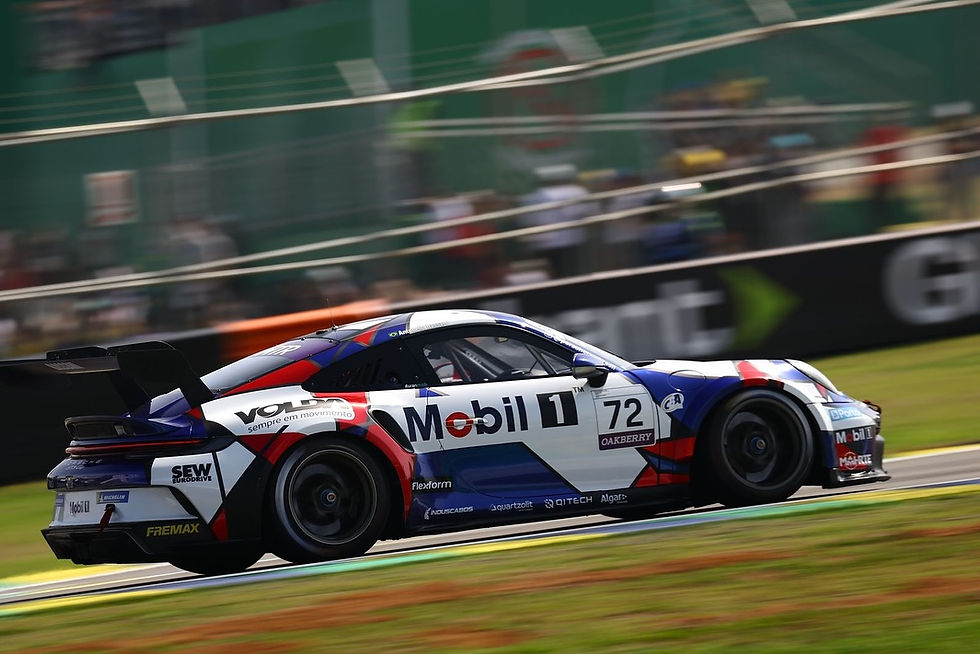
Supported by Mobil 1 and Porsche Brazil, and stepping into the Porsche one-make environment through the Young Racing Academy programme - a Porsche initiative designed to help young talents progress through the national ladder and potentially open international doors - she switched from karting straight into GT racing, a decision that would prove highly successful, and one that began paying off almost immediately.
On her debut in the 2023 Porsche Sprint Challenge Brasil and only days before she was formally announced as part of the programme, Bassani stunned the paddock by charging through the field to finish fourth. One round later she made history, becoming the first woman ever to score a pole position in the series, before converting that pace into a second-place finish and her first podium.

During her first full season in race cars, Bassani continued to rewrite the record books: at Goiânia she became the first woman ever to win in Porsche Cup Brasil, another highlight moment not only for her own career but for the championship itself. More podiums followed, another pole position, another race win and a season-long display of consistency ultimately secured her the Porsche Sprint Challenge Brazil title as a rookie, at just 17 years old and in her very first full year of car racing.
That season was followed by another campaign that was arguably just as impressive. In 2024, Bassani came within only a handful of points of repeating the achievement, again fighting at the front of the Porsche Sprint Challenge field and delivering another outstanding season that brought five race wins, multiple pole positions and fastest laps.
By the end of those two seasons, Antonella Bassani had emerged as one of the most exciting young female prospects anywhere in the world.
The next challenge came in 2025, when Bassani graduated to the main category of Porsche Carrera Cup Brazil.
The move represented a significant step up, not least because it meant learning the new Porsche 992 GT3 Cup car while racing against competitors who already had substantial experience with the platform. It was, in many ways, a reset: the start of a new learning process after dominating the Sprint Challenge.
And yet, even in that context, her progress was steady. She soon began breaking into the overall top ten as she adapted to the 992, and as the season went on she moved progressively closer to the top five, each round bringing more confidence, more pace and a clearer understanding of what she needed from the car. It was a season less defined by headline results than by solid progress.
At the same time, Bassani was also beginning to broaden her horizons beyond Porsche; in Brazil's premier motorsport series, Stock Car, she made her debut in the top class for two races and immediately delivered highly promising performances against one of the most competitive grids in South American racing. At Velocittà she secured a top-20 finish on her first weekend in one of the most fiercely contested touring car championships in the world, packed with elite Brazilian talent and veteran race winners.
At 19 years of age, every kilometre in that environment mattered and every outing was another opportunity to learn, a new car, new circuits and a new racing format.
That process continues into 2026, as Bassani returned full-time to Porsche Carrera Cup Brazil, now with a year of experience in the 992 and a clearer understanding of how to extract performance from the car. The results immediately reflected that: a pair of top-ten finishes became a pair of top-five finishes - the gap to the podium shrinking, and there was a sense, with each round, that the breakthrough result was not far away.
When it finally arrived, it did so on one of the biggest stages of all - Le Mans, and in front of the global sportscar community.
The Porsche Carrera Cup Brazil's trip to Le Mans was historic in itself, as the third round marked the first time the Brazilian championship had visited Circuit de la Sarthe and only its second trip to Europe after racing in Portugal the previous year. To compete as part of the support programme for the 24 Hours of Le Mans was an extraordinary opportunity for the series, giving its drivers a chance to race in front of the global endurance paddock at one of the most prestigious events in world motorsport.

For Bassani, the significance of the weekend went well beyond the race itself. This was a chance to perform in front of the people she hopes one day to race against, a chance to put her name in front of teams, engineers and decision-makers from the world she wants to enter.
From the moment she began speaking about the meaning of competing at Le Mans, it was impossible not to grasp just how much that meant to her.
"It's special for me. It's my first time here in Le Mans. It's a big, big circuit," she said when we spoke during the event, her words carrying a mix of excitement and disbelief for her first experience at the French legendary venue.
"And I'm so happy to be here with my team, with my mechanic, with my engineer. I don't know exactly the feeling because I have a lot of feelings in my mind right now. And sometimes confused to define what it means for me in the car, with the emotions."
What stood out in those first answers was a refreshing enthusiasm from a young driver genuinely trying to process what it meant to be racing at Le Mans, and what it might mean for her future.
"I need to thank and congratulate Porsche Cup Brazil for this event," she continued. "Sometimes I walked to the WEC paddock. And to think we are here with this championship, for me it's an absolute dream because my dream is to race in World Endurance Championship one day. And I'm here to work", she continued. "I would like WEC teams to watch - it's a good opportunity for me to be here with Porsche, with World Endurance Championship, for them to know my name."
That, perhaps, best captured where Bassani currently stands in her career: immensely grateful for the opportunities she has, fiercely committed to making the most of them, but also aware that each appearance on a stage like this can potentially open doors for something bigger.

Asked how she assessed her progress in Carrera Cup over the last two years, Bassani framed it with the maturity of someone who understands the learning curve.
"The last year I debuted in Carrera Cup," she said. "And it was my first time with the car, my first time with the 992. And a lot of people here in Porsche Cup race with this 992.1 car for a long time."
"I debuted last year, so sometimes I thought I just needed to finish the races to get time in the car. And lap by lap I've been getting better."
"In my mind, every round with Porsche this year has to be a further step," she continued. "One of the targets for this year is that I would like to win one race. And my dream would be to win here in Le Mans, as well as [the support round of] Formula 1 in Brazil."
Le Mans and Interlagos; two big stages of international motorsport, two huge audiences with important heritage that also somehow represent Bassani's career so far. Two venues to prove herself not only in front of her home crowd but also in front of the international racing world.
"I think it's very difficult sometimes for Europeans and Americans to look at Brazil. They always look at Europe and America, especially Europe. Brazil is seen like a small country, but we have a lot of quality in Brazil."
Brazil is obviously not a small country in motorsport terms - it is one of the most historically significant nations in racing, with a deep talent pool, a fierce domestic scene and a heritage that stretches from Ayrton Senna to modern-day champions across multiple disciplines. But what Bassani highlighted is often the difficulty of being seen from the outside when your career is being built far from the European centre of gravity that still defines so much of the sport.
"The driving [in Brazil] is amazing," she said. "But sometimes we don't have money to go racing in Europe. And when Porsche comes here, it's in my mind I think, so this is the time for the teams to know who I am."
There's both ambition and realism in her statement, as Antonella knows there is a financial barrier to an international campaign and that many Brazilian sponsorship programmes are built around national platforms - and that translating domestic success into international opportunities requires more than speed alone.
"The cost is higher [to race outside of Brazil]. But it's my dream to race here in Europe. Every time I tell my family that if I need to live here in Europe alone, of course I'm going to. But now I need to race and do well in Brazil, and we'll look to Europe after."

What made those words more compelling was that Bassani backed them up with her strongest weekend of her season to date. At Le Mans, in fact, she produced a remarkable performance culminating in a second-place finish and her first-ever Porsche Carrera Cup podium at one of the most iconic circuits in the world. Competitive from the outset, Antonella learned quickly a circuit she had never raced on before, and handled the scale of the event with maturity, knowing that the second race would produce her best chance.
She barely had time to process it before another challenge arrived: just days after the historic result at Le Mans, Bassani was back in Brazil for another appearance in Stock Car, stepping into the Full Time Sports-operated Toyota Corolla Cross as a substitute for former Formula 1 driver Ricardo Zonta in the Toyota Gazoo Racing entry at Cuiabá.
Once again, she made the most of it: after finishing 27th in the sprint race, she launched an extraordinary recovery in the main race, charging from 28th on the grid to finish 13th, her personal best in just her second weekend in the series. It was her first time racing at Cuiabá, her first time driving at night and in front of a championship that remain among the toughest proving grounds in South American motorsport. When it matters the most, Bassani delivers.
One of the key figures in Bassani's development over the last few years has been Bia Figueiredo, the former IndyCar racer and one of the most important figures for women in Brazilian motorsport, who now helps Bassani's career.

"Bia is amazing," she said. "For me, when I was eight or nine, and today too, she has been my idol. She and Rubens Barrichello, you know? And Bia now works with me, manages my career. I need to thank Bia for everything."
Figueiredo, who herself continues to compete successfully in the Copa Truck, is someone who understands the specific challenges of building a motorsport career as a Brazilian woman in a global sport. For a young driver like Bassani, having that guidance is invaluable, particularly at this stage in her career.
There was something striking about speaking to Antonella at Le Mans, because even before the podium, and certainly after it, you could feel how much this platform meant to her. It was there in the way her eyes lit up, in the way she described walking through the WEC paddock, in the way she balanced gratitude for the opportunities she has with hunger for more. Bassani loves sportscar racing and understands what Le Mans represents - and it's not a stretch to imagine her in that environment in the near future.

Brazilian motorsport remains a formidable proving ground, with deep competition and an extraordinary racing heritage, and there is undoubted value in continuing to build a career there. But at the same time, it is hard not to feel that Bassani deserves to be seen on a broader stage, because she is one of those drivers whose performances consistently suggest there is more to come if given the right backing, the right programme and the right international platform.
In a sport that is still learning how to tell more varied stories about female talent, Antonella Bassani feels like an important one. She is proof that there is no single blueprint for building a meaningful racing career, and that GT and endurance racing are a high-level destination rather than a fallback.
Proof that some of the most exciting young drivers in the world are not always the ones being talked about the loudest. And hopefully, she is one step closer to changing that.


