2025: Women In Motorsport, a year in review

Our annual in-depth review of the biggest stories, emerging trends, top talents and key challenges shaping women in motorsport during the 2025 season.

The 2025 season marked one of the most complex yet successful years yet for women in motorsport. It was a year defined by contradiction: unprecedented growth at entry-level single-seaters, historic milestones in female participation in mixed-gender grids, and remarkable success stories in GT and endurance racing, contrasted by some stagnation, and in some cases regression, at the middle and upper levels of the single-seater ladder.
While investment, visibility, and structured development initiatives are clearly reshaping the base of the pyramid, the data from 2025 highlights the challenges of climbing the single seater ladder that remains unresolved - as well as endurance racing as the stronghold of female talents and performance.
The most powerful trend of 2025 was the dramatic surge of female participation at Formula 4 level. Across global F4 championships, almost 80 female drivers competed during the season, with 57 racing in mixed-gender grids. This represented a +64.5% increase compared to 2024, and a still-significant +29.16% rise even when excluding Japan’s Kyojo Cup. No other level of racing experienced anything close to this growth for female entries.
Two forces primarily drove this expansion. The first was F1 Academy, which continues to function as the biggest drive accelerating the transition from karting to cars for a growing generation of female drivers. The second was Kyojo Cup’s technical shift from prototype machinery to F4 cars, instantly aligning Japan’s all-female championship with the single-seater pathway and inflating F4-level numbers.
These drives, combined with increased manufacturers backing, scholarship programs, and clearer career roadmaps, produced a visible wave of first-time F4 entrants. Around 20 drivers arrived directly from karting, highlighting the progress made at grassroots levels.
National F4 championships worldwide reflected this momentum. The symbolic peak of the season came in the F4 Saudi Arabian Championship. After already approaching gender parity earlier in the year, the season finale at the Jeddah Corniche Circuit delivered an unprecedented milestone: for the first time in history, a mixed-gender single-seater championship featured a majority-female grid. Eight women took the start, accounting for 57.1% of entries.

Beyond the headline statistic, the sporting context was equally significant. Nina Gademan secured the Female Trophy despite only contesting a handful of rounds, building on her overall podiums in Bahrain. Payton Westcott arrived fresh from her first single-seater victory in Dubai in Formula Trophy; Farah Al Yousef, Ava Dobson, Chiara Bättig - making her single-seater debut after a remarkable karting career - Megan Bruce, Rachel Robertson, one of the most improved drivers of the year, and Esmee Kosterman, multiple-time Female Trophy race winner, formed one of the most promising female line-ups seen this year.
At the top of the media attention, F1 Academy produced one of its strongest sporting seasons to date. The championship evolved into a compelling title fight initially between Doriane Pin, Maya Weug and Chloe Chambers, before narrowing to a season-long duel between Pin and Weug that went down to the Las Vegas finale.
Weug opened the year in formidable form, before a devastating round in Canada - marked by technical failures - swung momentum decisively. Pin capitalized with relentless consistency, while Chambers endured her own misfortune but remained a benchmark in qualifying pace and racecraft, delivering some of the season’s best overtaking moves. All three drivers, in their final eligible season, performed under pressure with Pin ultimately emerging champion after a difficult final weekend for Weug.
Yet even as the racing product strengthened, the championship’s biggest unanswered question persists: progression. With all three title protagonists now graduating, their next steps remain uncertain, and the broader 2025 data suggests that the pathway beyond F4 remains the weakest link.
Outside F1 Academy, 2025 saw one of the richest and diverse pool of female F4 entries on record. Italian F4 welcomed notable new entrants: Emily Cotty emerged as one of the season’s most impressive performers, running towards the top-ten in one of the world’s most competitive F4 grids, producing standout qualifying performances - particularly in Barcelona - and later becoming the only female starter at the Macau Grand Prix. Payton Westcott showed early promise with a strong Formula Winter Series campaign and wrapped up her year with a Formula Trophy Middle East victory in Dubai.

Mathilda Paatz was among the most consistently competitive female drivers anywhere in F4. Running her family-operated team in F4 Central European Zone, she claimed podiums and remained a front-runner all season before stepping into E4 and Italian F4, immediately fighting for Female Trophy victories.
British F4 again functioned as a high-value dual-program platform for Ella Lloyd and Alba Larsen, who balanced their F1 Academy commitments with British-based campaigns, both running competitively in the Challenge Cup. Lloyd finished runner-up and scored an overall podium. Nina Gademan and Chloe Chong also contested solid partial programs in British F4.
Emma Felbermayr used Spanish F4 to accelerate her development in F1 Academy, eventually earning a race win in the all-female series on her first season of car racing.
Esmee Kosterman’s trajectory became one of the year’s most interesting stories: rapid progress in British F4, the only wildcard to score points in F1 Academy, confirmation of a full-time 2026 F1 Academy seat and a consistently front-running campaign in Saudi F4 where she finished every race inside the top ten and narrowly missed a first overall podium.
Success stories emerged across every continent. Ivanna Richards scored her first NACAM F4 podium in Puebla; Rafaela Ferreira returned to Brazilian F4 to win outright at Interlagos. In India, Annabel Kennedy claimed the first female podium in series history, with Clara Stiebleichinger and Paige Raddatz showing steady progression. In Australia, Imogen Radburn claimed six podiums and was fourth overall in AU4 despite missing a round.

The GB4 Championship again proved to be one of the most effective training grounds, combining large grids, a professional environment and tangible incentives such as the €50,000 F1 Academy prize fund. Multiple rookie female drivers used the series as a first major step into car racing with Ava Dobson and Megan Bruce emerging as the two top females.
Scandinavia continues to provide opportunities for young women at entry level single seaters. Alexia Danielsson enjoyed her best Nordic4 season while also winning on her Porsche Sprint Challenge debut. Mille Hoe remained a consistent points finisher, as Louise Larsson claimed podiums and top fives in Formula Nordic.
In the US junior ladder, Emma Scarbrough and Kaylee Countryman frequently ran inside the top ten in USF Juniors, while Ava Hanssen emerged as the leading female in Ligier Junior Formula.
Meanwhile, all-female Japan’s Kyojo Cup became one of the biggest stories of the year. Rio Shimono dominated, while Miki Onaga and Aimi Saito also took race wins. Kokoro Sato, Rami Sasaki, Mako Hirakawa, and Riona Tomishita all reached the rostrum, in a season that shone a light on numerous Japanese talents also overseas thanks to the all-female project.

If F4 represented expansion, Formula Regional embodied contraction. Only eight female drivers appeared at this level in 2025, an 11% decrease from 2024 - and far fewer full-season campaigns. Just four in fact completed their programs.
This decline continues a trend visible since the dissolution of W Series. Critically, the spike at F4 has not yet translated into sustained F. Regional progression. Three drivers combined F4 and Regional campaigns but halted their Regional efforts before season’s end, highlighting the financial and structural fragility of this step for female racers.
Doriane Pin’s partial FRECA campaign illustrated this difficulty: despite her proven pedigree, results were challenging before her early exit. Maya Weug’s one-off appearance showed the same struggle. Nicole Havrda halted her Formula Regional Americas campaign after only one round, just as Victoria Blokhina shifted focus to endurance racing after initially entering Eurocup-3. In Japan, Anna Inotsume and Ai Miura recorded top fives but lacked podium contention in Formula Regional Japan.

GB3 Championship offered a more positive counterpoint. In the year of a new car and a European-focused calendar, reigning F1 Academy champion Abbi Pulling delivered a strong rookie season, including a top five on debut at Silverstone and a podium at Brands Hatch. Bianca Bustamante, also stepping up from F1 Academy, faced a steeper learning curve but gained vital experience.
Solenn Amrouche’s story was among the most encouraging: after beginning racing only a few years ago in endurance, she transitioned into the Hoosier Formula Cup, which employs the Tatuus T318 machines. The French racer improved rapidly and scored an overall podium at Aragón.
Still, the broader message remains: Formula Regional level and upwards so far represents the system’s weakest structural link for female drivers' progression.

The contraction intensified above Formula Regional. Only three women competed at what could be defined as third-tier or higher single-seater levels - and only two completed their seasons. For the first time since 2021, no female drivers competed in the FIA F3 or F2 fields.
Sophia Flörsch’s Indy NXT campaign lasted just one round despite an encouraging debut. Hailie Deegan completed the season, facing the expected challenges of transitioning from NASCAR to high-downforce cars, but made steady progress. In Super Formula, Juju Noda continued her development in the family-operated Triple Three Racing, fighting hard but finishing without points.
The trend from 2025 is stark: outside F4, the single-seater pyramid remains fragile. Endurance racing is in fact where opportunity is translating into results.

While the single-seater pyramid continues to struggle with progress after F4 level, endurance racing and prototypes have increasingly become the most tangible avenue for elite female drivers to reach and compete at the highest levels of international motorsport. In 2025, that reality was reinforced not by participation growth, but by the competitive relevance of the women involved.
At LMP2 level, numbers remained static following the sharp decrease of 2024, with only one full-time female presence. Yet the quality of that presence made the category one of the most important reference points of the year. Jamie Chadwick’s transition from Indy NXT to prototypes was in fact a sporting statement: from her first endurance outings, she demonstrated immediate adaptability to multi-class racing and long-run consistency - which soon saw the British star making headlines.
Chadwick would win at debut and remained in championship contention until the final round in European Le Mans Series. Her Le Mans 24 Hours debut, although ultimately compromised by technical issues, was also particularly significant: she ran at the front of the LMP2 field on pace, showing that her ceiling in endurance racing is far from reached.
Her inclusion in the Genesis Magma program as a development driver in the hypercar project further illustrated the growing recognition among manufacturers, as top female single-seater graduates increasingly find success in endurance competitions. Chadwick’s 2025 campaign showcased how quickly talented women can become title contenders when placed in elite structures.

At the very top of endurance racing, the continued absence of women in full-season Hypercar programs remains one of the important steps to reach for the sport. Vanina Ickx’s appearances over a decade ago still stand as the last race entries by a woman in the top endurance category. Yet 2025 also delivered signals of proximity: Lilou Wadoux’s continued Ferrari Hypercar testing through the WEC rookie test and Chadwick’s manufacturer-backed development role both suggest that the barrier is no longer a long-term one.
Three drivers competed at LMP3 level, and while the raw numbers did not rise, the sporting impact was notable. Léna Bühler’s season in Michelin Le Mans Cup was one of the most important breakthroughs by a female driver in prototypes in recent memory. After making her sportscar debut, Bühler immediately became a front-runner, fighting for pole positions, collecting overall podiums, and winning races. Her outright victory at Le Mans in Race 2 was eventually a moment of global visibility that placed a female driver at the center of one of endurance racing’s most iconic stages.
Beyond Le Mans Cup, an alternative prototype ecosystem continued to play a crucial role: in the Ultimate Cup, Belén García returned to ANS Motorsport in the NP02 prototype and produced one of the most consistently competitive campaigns of her career. Regularly fighting at the front, she secured three podiums and remained in contention across a tightly matched field, ultimately finishing fourth in the standings. Cindy Gudet’s prototype debut, alongside dual commitments in GT4 Europe and the Ligier European Series, further demonstrated the growing opportunities of the Ultimate Cup series in prototype development routes.

If endurance racing is where opportunities are emerging, GT racing is where competitive parity is often being achieved.
Although the total number of female drivers in major GT3 championships declined in 2025 - returning to roughly 2023 levels after the expansion of 2024 - performance at the top level increased. The women who did compete at this level were in fact not filling grids, but they were fighting for championships.
Lilou Wadoux’s season stood as one of the most significant achievements by a female driver in modern GT racing. Her dominant victory at the IMSA season finale, the Motul Petit Le Mans, secured the IMSA Michelin Endurance Cup title and made her the first woman to claim an IMSA championship since Christina Nielsen in 2017.
In Europe, her first ELMS campaign with Richard Mille AF Corse brought two wins and the LMGT3 vice-championship, instantly establishing the French racer as one of the category’s elite drivers. Wadoux’s 2025 was not an isolated success; it was yet another proof that within fully professional structures, women are now regularly championship contenders.

The European Le Mans Series itself became arguably the most important championship for women in motorsport across all disciplines. Victories, title fights, and manufacturer-backed line-ups placed female drivers at the core of the narrative. Iron Dames, despite a challenging WEC campaign initially marked by BoP struggles and misfortune, remained ELMS protagonists. The integration of Célia Martin as a new bronze driver proved immediately competitive, while Sarah Bovy’s transition from bronze benchmark to high-performing silver driver further reinforced the program. Alongside Michelle Gatting, the trio won at Barcelona and remained in championship contention deep into the season.
GT3 also saw the arrival of new front-runner. Marta García’s debut season with Iron Dames in Michelin Le Mans Cup immediately repositioned her as one of the most promising women in GT racing. Despite setbacks such as a huge crash and missed rounds to no fault of her own, she claimed a race victory alongside the returning Vanina Ickx and consistently demonstrated front-running pace.
It was a very unlucky campaign for Jessica Hawkins in her rookie season in GT World Challenge Europe, as she barely managed to get significant time behind the wheel due to a series of incidents across most rounds. In contrast, Renee Gracie enjoyed another title-winning year in GT World Challenge Australia, dominating the AM class with seven victories from ten races before stepping up to ProAm for the final round of the season.
Meanwhile, Samantha Tan completed her first solo season at GT3 level by joining the IMSA VP Racing Sportscar Challenge in the new GTX class, where she secured the Bronze category championship and continued her strong climb toward top-level IMSA competition.

In GT Cup competitions, the pattern repeated. Laura van den Hengel’s ProAm title in GT Cup Europe - achieved in her first season within the Iron Dames-supported program - made her the first woman to win a championship on the GT Sport platform with a dominant season in class. After a challenging start of the year, Manuela Gostner’s very consistent Ferrari Challenge Europe campaign resulted in the Shell category title.
Across Porsche Carrera Cup championships worldwide, female participation increasingly aligned with performance. In PCC North America, the three women on the grid were consistently running inside the top ten, with Sabré Cook a regular front-runner, while Ashley Freiberg was unfortunately forced to halt her campaign after an accident due to budget constraints.
In Brazil, Antonella Bassani stepped up to the main class of Porsche Carrera Cup Brasil and made a significant leap forward: although she is not yet a race winner, she was already fighting for podiums. In the 991 class, former single-seater driver Cecilia Rabelo enjoyed a positive debut season.

In Porsche Carrera Cup Germany, Europe’s top one-make Porsche series, Alexandra Vateva and Emily de Heus both made a major step into a highly competitive environment and showed encouraging progress; however, De Heus, in her first year in sportscar racing, was forced to halt her season early. In Scandinavia, Isabell Rustad stepped up to the main category of Porsche Carrera Cup Scandinavia and emerged as the top rookie, reaching her qualifying targets and battling solidly inside the top ten.
Iron Dame Karen Gaillard competed in Porsche Carrera Cup France, another outstandingly competitive championship, where she made progress at every round, and also claimed a race victory in Porsche Sprint Challenge Switzerland.
The Lamborghini Super Trofeo North America season added another highlight to this season. The RAFA Racing Team’s all-female line-up of Lindsay Brewer and Jem Hepworth secured multiple podiums and two victories in the AM class, narrowly missing the title in their debut season. Brewer’s direct transition from Indy NXT to GT racing - and immediate competitiveness - echoed a recurring theme of 2025, with women switching from single-seaters to sportscars being increasingly competitive from the outset.

GT4 remained one of the most numerically stable environments for female drivers. With around 30 competitors across major championships, numbers plateaued rather than expanded, but the long-term growth trend remained strong, more than doubling over five years.
The Porsche Sprint Challenge platform once again played an important role, with a very competitive trio of women racing in North America and a solid presence in Europe, particularly in Great Britain, where several class titles were achieved. In France, the FFSA championships also delivered encouraging performances, with Jodie Sloss making the leap into her first international campaign.
In FFSA GT, it was an excellent year for Sloss, who was consistently on the AM class podium while learning new tracks and improving round after round, eventually closing the season third in the standings. In GT4 America, within a strong field and highly competitive environment, the all-female Heart of Racing Team pairing of Hannah Grisham and Hannah Greenemeier continued their progress, scoring podium finishes and securing fifth place in the championship standings in the top Silver class. In the AM class, Laura Hayes made her debut and was regularly fighting for class wins; despite being very unlucky with technical issues at most rounds, it was nevertheless a remarkable first season for the Thunder Bunny Racing driver.
Another all-female team stood out in GT4 Europe, with the Matmut Evolution 100% Feminin project fielding Gabriela Jílková and Cindy Gudet in their second year together. The duo claimed five ProAm podiums in one of the world’s top GT4 championships, finished runner-up at both Misano and the Nürburgring, and ultimately ended the season fifth in the standings. Reema Juffali also returned to competitions with an appearance in GT4 Europe, immediately showing strong pace.

In the top class of the IMSA Michelin Pilot Challenge, racing newcomer Christine Sloss delivered solid performances and improved at every round, eventually battling at the front of the GS Bronze category.
Highly convincing in the GS class was Alexandra Hainer, who entered one round at Indianapolis and managed to contend for the overall victory straight away, eventually finishing second. On her rookie season at this level of GT competitions, Hainer shone also in the McLaren Trophy North America, where she claimed the ProAm title with a remarkably quick and mature season.
In Iberian Supercars, Nerea Martí fought for victories all season in the factory BMW entry, while the series also showcased several female talents, including Chloe Grant, who made her GT4 debut from single-seaters and was immediately competitive, as well as Gracie Mitchell and Alba Vázquez, who were running at the front in the GTX class.
The Porsche Sprint Challenge ladder continues to be a particularly valuable opportunity for female drivers, especially in the United States through the Mobil 1 development program, which saw Loni Unser, Erika Hoffman, and Anna Cecchi standing on the podium and winning races in the Cayman category, with Cecchi making significant progress over the course of the season.
In the UK series, female participation was again strong, with Hannah Chapman winning the CS Am class title, while series newcomer Lydia Walmsley impressed with class race wins, alongside equally notable performances from Aimee Watts and Katia Loggie.

Touring car and grassroots championships continue to serve as both entry points and development pathways. While global TCR participation remains below its 2022 peak, IMSA Michelin Pilot Challenge’s touring car class, NXT Gen Cup, and regional touring series provided competitive and visible platforms.
Maddie Aust made her debut in the IMSA Michelin Pilot Challenge and impressed immediately with her consistency, running solidly inside the top five in the Bryan Herta Autosport Hyundai. Riley Pegram and Megan Tomlinson both raced alongside their fathers and regularly battled inside the top ten; although bad luck often prevented them from capitalising on their potential, they showed improved pace. Christina Lam contested a part-time campaign and recorded two top-ten finishes, while two-time champion Taylor Hagler returned for a one-off appearance at Watkins Glen and finished inside the top ten.
In the 24H Series by Creventic, Pia Ohlsson deserves special mention after winning both the Dubai 24 Hours and the Barcelona 24 Hours in the TCE class. In Brazil’s premier motorsport series, Stock Car, young rising star Antonella Bassani made her debut in the top class for two rounds and delivered a highly promising performance, scoring two top-20 finishes. In the Stock Car Light category, the main stepping stone to the premier class, Bruna Tomaselli stood on the overall podium at Velopark and finished ninth in the championship with two additional top-five results, while Kaka Magno also achieved two top-ten finishes, including a career-best sixth place.

The all-electric touring car NXT Gen Cup enjoyed a major year for female drivers. Young Swede Siri Hökfelt became the first woman to win a race in the history of the series at the Sachsenring, a feat matched the following day by Patricija Stalidzane. The Latvian driver was among the protagonists throughout the season, scoring six podium finishes and regularly fighting for victories; despite a few DNFs that ultimately ruled her out of the title fight in a short calendar, Stalidzane maximised her opportunities to finish fourth in the championship and also demonstrated her speed in the Nürburgring with the all-female Girls Only team in NLS.
In TC America, Sally McNulty returned to the championship in the top class, but it was Alana Carter who made the headlines by claiming a class victory on her series debut at Barber.
The Mazda MX-5 Cup in the United States and the Ginetta Junior Championship in the UK once again proved to be key entry points into car racing and outstanding training grounds for progression.
Mazda Women’s Scholarship winner Ashlyn Speed was joined on the grid by seven other women over the course of the season, although only Sally Mott was the other driver able to contest all rounds.
Mott was the strongest female competitor and achieved top-ten finishes in the massively competitive field. Heather Hadley delivered solid performances, while RAFA Racing’s Maite Cáceres and Caroline Candas battled for several female awards in the first half of the season but were unable to complete the campaign. Speed made steady improvements, as did Charlotte Traynor, who would go on to win the 2026 scholarship, while Hepworth made a one-round appearance alongside Sally McNulty.

In the UK, the Ginetta Junior Championship continues to attract increasingly young drivers, allowing them to move into car racing earlier before progressing to single-seaters, with an exceptionally high level of competitiveness. In 2025, Katrina Ee from Malaysia/Hong Kong was the only female entry. Stepping up from karting, she closed progressively on the front of the field with each round in a learning-focused season, recording a personal best finish of 13th. However, her year was cut short by a major crash at Zandvoort, after which she took the remainder of the season to recover.
Ashley Gregory competed in the Vertu MINI Challenge Trophy and ended her season on a high by securing her first pole position at Brands Hatch, leading laps and gaining valuable experience at the front of the field. In her first full season of circuit racing, Millie Hart secured the Nankang Tyre BMW Supercup Championship title. Hart was a model of consistency throughout her debut campaign, scoring two victories and completing every lap of the season.
Sportscar and single-seater veteran Katherine Legge made her NASCAR Cup Series debut at Phoenix Raceway, driving the #78 Chevrolet, becoming the first woman to compete in the Cup Series since Danica Patrick at the 2018 Daytona 500. After an initial period of adaptation, Legge went on to score a top-20 finish on the Chicago Street Course, crossing the line 19th, the best result for a woman in the Cup Series since Patrick eight years earlier, and her personal best in the category. She later improved again at Indianapolis Motor Speedway with a 17th place, securing her second top-20 finish of the season.
Alongside her Cup appearances, Legge also contested a part-time NASCAR Xfinity Series campaign, collecting valuable seat time. She qualified strongly at Talladega Superspeedway, setting a faster lap than 14 cars, including two teammates, and during the race became only the fourth woman in history to lead an Xfinity Series event.

In the NASCAR Truck Series, Toni Breidinger was the sole female competitor and a full rookie. She endured a challenging season, with a best result of 18th at Rockingham Speedway and another top-20 finish at Kansas. Breidinger however made steady progress and completed several clean races, though results did not always reflect her potential.
The ARCA Menards Series once again proved a major proving ground for women in American stock car racing, with ten women starting at least one round. The standout was rookie Isabella Robusto, who was consistently among the frontrunners, scoring 14 top-ten finishes, nine top fives, and two podiums, narrowly missing out on her first win but often coming close. She ultimately finished fourth in the championship standings, confirming her status as a major emerging talent.
Lanie Buice, 19, contested four races, finishing twice in the top ten and impressing with solid performances. Becca Monopoli enjoyed a positive part-time campaign with a top-ten finish, as did Regina Sirvent, a star of NASCAR Mexico making her U.S. debut in three races. Taylor Reimer also made a promising impression, scoring a top-five finish and placing in the top ten in all three of her starts. Amber Balcaen, Kaylee Bryson, Jade Avedisian, Mandy Chick, Logan Misuraca, and Katherine Legge also took part in at least one ARCA round.
Jade Avedisian made further history by becoming the first woman to win a race in the CARS Pro Late Model Tour, triumphing at New River All-American Speedway. She also made her ARCA national series debut with one round and competed in the ARCA West Series.
Elsewhere in global stock car racing, Regina Sirvent enjoyed a solid season in NASCAR Mexico, scoring a top-ten finish and making the cut for the playoffs. Major headlines also came from the Trucks Mexico Series, where female drivers were consistently at the front: Valeria Aranda fought in championship contention and was close to victory on multiple occasions. Former single-seater and F4 race winner Alexandra Mohnhaupt claimed Rookie of the Year honors, finished sixth in the standings, and showed remarkable progression across the season. Fifteen-year-old Sol Díaz ended the year 12th in the championship, gaining valuable experience.
In Europe, EuroNASCAR once again proved a strong platform for female drivers. Veteran Arianna Casoli was unfortunately forced out of the season after sustaining injuries in a major crash at Vallelunga in round two. German newcomer Vanessa Neumann, also known as Happinessa, won the Female Trophy after a learning-focused season, her efforts rewarded with consistent improvement.
Karting remains another extremely important area to monitor and continues its positive trend at the highest levels of competition, with an increasing number of young female drivers who are also becoming ever more competitive on the international stage.
The ongoing efforts of F1 Academy through the Champions of the Future Academy Program represent a significant step in the right direction, already helping to boost participation and identify high-level talent. After Luna Fluxa’s championship success in 2024, a new wave of drivers was battling at the front one year later, with Chiara Bättig, Klara Kowalczyk, and Ella Häkkinen all establishing themselves as highly promising prospects for the future.

The 2025 season will stand as a significant year for women in motorsport not because every barrier was shattered, but because the trends and structure of the challenges have became clearer. At the base of the pyramid, the surge in F4 participation starts to bear fruits after the last few years' efforts - demonstrating that progress is being made to widen the pyramid. However, the single-seater ladder up into Formula Regional, third tier and above remain fragile and especially underfunded, with inconsistent progress.
At the top of the professional GT and endurance competitions, however, the sport reached a point where women are no longer exceptions but rather race winners and championship contenders. However manufacturer-backed programs and female-oriented investors remain key to the long term sustainability of top female talents in elite championships.
2025 proved that talent is there; it proved that, when placed in competitive machinery, female drivers win at the highest levels of GT and endurance racing. The challenge now is not one of visibility or potential, but of long term planning from manufacturers and investors; the future of women in motorsport will in fact be determined by how many of the talents entering today will be supported to progress five years from now.
TOP TEN
Like every year, a list of correspondents, journalists and website contributors voted for their best drivers of the season, and as usual, compiling the top ten was no easy task, with many protagonists receiving recognition. In total, 36 drivers received at least one vote, while 16 drivers earned two or more votes. One driver, however, stood out above all others, as she was unanimously selected by every voter as the 2025 top woman in motorsport.

LILOU WADOUX
Lilou Wadoux’s 2025 season confirmed her as one of Ferrari’s leading GT drivers, combining major successes at the highest level of endurance racing. The French racer also returned to the cockpit of Ferrari’s 499P Hypercar at the FIA WEC Rookie Test in Bahrain, stepping into the Le Mans-winning prototype for her third test outing in the current-generation Hypercar.
Since joining Ferrari’s factory ranks, the 24-year-old from Amiens has rapidly established herself as a reference within the Prancing Horse, becoming Ferrari’s first female factory endurance driver in 2023 and the first woman to win a FIA WEC race with her GTE Am victory at Spa-Francorchamps.
In 2025, Wadoux enjoyed another outstanding campaign with the Ferrari 296 GT3 across both North America and Europe. She claimed victory at the IMSA Motul Petit Le Mans, securing the IMSA GTD class Michelin Endurance Cup title alongside Alessandro Pier Guidi and Simon Mann.
In ELMS, Wadoux consistently fought at the front of one of the world’s most competitive sportscar fields, combining speed and racecraft to remain firmly in the title fight throughout the season.
Wadoux concluded her ELMS campaign with a determined drive in the 4 Hours of Portimão, finishing vice-champion in the LMGT3 standings with Richard Mille AF Corse teammates Riccardo Agostini and Custodio Toledo. Entering the finale as championship leaders, the crew faced a difficult weekend due to heavy success ballast, but Wadoux’s final stints always showed her form with victories at Paul Ricard and Silverstone and a fifth-place finish at Spa.
Already a history-maker in FIA WEC, IMSA and Japan’s Super GT, Wadoux’s 2025 season further cemented her position as a leading figure for women in motorsport: often less visible for her reserved character, but a true role model for the youngest generation.

DORIANE PIN
Doriane Pin’s campaign was defined by a season-long title battle in F1 Academy, culminating in her securing the championship at the season finale in Las Vegas. Pin entered the year as one of the clear title contenders alongside Maya Weug and Chloe Chambers, with all three competing in their final eligible season under the series’ two-year rule.
Pin capitalized on consistency throughout the year, building her campaign on regular points finishes and key victories. After taking her first win in Shanghai, she returned to the podium in Jeddah’s second race and claimed victory along with the fastest lap in Miami. She maximized the Montreal weekend with another win and a third-place finish, seizing the championship lead from Weug and then managing the pressure as Weug mounted a recovery later in the season. Pin went on to finish third in Zandvoort, second in Singapore, and secured a decisive victory in the first race at Las Vegas, completing the year with all but one result inside the top five.
Alongside her F1 Academy program, Pin continued her single-seater development in the Formula Regional European Championship with Prema after transitioning from sportscars in 2024 as part of the Iron Dames program. Her 2025 FREC campaign proved more challenging, with Pin contesting only four rounds before halting her season after the Paul Ricard event. Her best results were two 17th-place finishes, alongside five top-20 results, but she struggled to get closer to the points compared to the previous season.
After the summer break, she fully refocused on F1 Academy and made the most of her final year in the all-female championship, achieving the goal set for her when she joined the series as one of the leading women in sportscars. Her prize for winning the title has not yet been announced, with a possible return to endurance competitions anticipated.

MAYA WEUG
After strong campaigns in Italian Formula 4 before stepping up to FRECA in 2023, the first female driver to join the Ferrari Driver Academy made her F1 Academy debut in 2024 with Prema Racing, representing Ferrari. She secured eight podiums and one victory, ultimately finishing third in the standings in her first season.
For 2025, Weug switched to MP Motorsport to continue her pursuit of the F1 Academy title. After opening the season with four consecutive podiums and a win in Jeddah, a difficult round in Canada cost her the championship lead.
She nevertheless mounted an impressive late-season comeback, returning to winning form in Zandvoort and Singapore and scoring four consecutive podium finishes to rejoin the title fight. Although she was unable to challenge Doriane Pin for the crown at the Las Vegas finale, Weug concluded the season as vice-champion.
Her campaign was particularly notable for her fighting spirit, as she mounted a strong recovery and fought until the very last lap of the season, a commendable effort for one of the highest-profile drivers in the series and a worthy championship contender.
The Dutch driver also made a one-off appearance in FRECA at the Hungaroring with Saintéloc Racing, where she was unfortunately unable to break into the top 20. As a prize for her vice-championship, she was awarded a funded GT3 test, driving the AF Corse Ferrari 296 GT3 at the Circuit de Barcelona-Catalunya.

LAURA VAN DEN HENGEL
Barely two years after taking her first steps in race cars, Laura van den Hengel completed a breakthrough 2025 campaign that established her as one of the most exciting bronze-rated prospects in GT racing. The Dutch driver, who transitioned directly from karting into Porsche GT3 Cup machinery, has built her career without major backing, relying instead on determination and self-constructed programmes. After a learning season in GT Cup Europe, van den Hengel’s progress attracted the attention of Iron Dames, who welcomed her into their new “Supported by Iron Dames” programme at the start of 2025, raising her international profile.
Armed with renewed momentum, van den Hengel assembled a strong programme for her second full-time GT season, with newly formed Burgers Motorsport by HWM and teaming up with experienced racer Paul Meijer. The pairing quickly became the ProAm benchmark, frequently fighting on the overall podium. Their season opened with a class victory at Portimão after a last-corner battle for the overall win, before an early-race accident ended the second contest. The response was immediate: domination at Spa-Francorchamps followed, then another emotional weekend at Hockenheim, where front-running pace was again undone by a major crash, only for Laura to storm from last to second in Race 2.
Her strongest performance came at Paul Ricard, where two class wins and a second overall highlighted van den Hengel’s opening stint. The momentum carried through Barcelona, where a hard-fought Race 2 class win extended their championship advantage heading into the finale at Monza. There, van den Hengel sealed the crowning achievement, clinching the 2025 GT Cup Europe ProAm title.
In just her second full season in GT racing, she became the first woman to win a GT Sport championship title and the only Iron Dames-associated driver to secure a GT title in 2025.

JAMIE CHADWICK
Jamie Chadwick spent the 2025 season as part of Genesis Magma Racing’s Trajectory Programme, competing in the European Le Mans Series and at the 24 Hours of Le Mans with IDEC Sport in an LMP2 Oreca 07-Gibson - her first year in endurance racing switching over from Indy NXT.
Teaming up with Mathys Jaubert and Daniel Juncadella, Chadwick enjoyed a remarkable rookie campaign in LMP2, securing three class victories - two of them outright wins - and finishing third in the drivers’ championship.
Her rapid adaptation to endurance racing was evident from the opening round, where the trio claimed the LMP2 class win and finished second overall at Barcelona. Chadwick backed that up with her first outright victory at Le Castellet in only her second prototype start.
Although contact involving Juncadella denied the crew points at Imola, and a post-race penalty cost them a podium at Spa-Francorchamps, the team responded in style with a commanding victory at Silverstone in mixed conditions, reigniting their championship challenge heading into the Portimão finale. A third-place finish in Portugal sealed Chadwick’s fourth podium of the year and cemented her third place in the final standings.
Chadwick’s impressive campaign was rewarded with her first Hypercar test, driving the GMR-001 at Magny-Cours, confirming her place within the manufacturer’s Hypercar development programme ahead of Genesis Magma Racing’s entry into the top class in 2026.

ABBI PULLING
Reigning F1 Academy champion Abbi Pulling earned a major step up in 2025 by joining the GB3 Championship, a significant progression with the introduction of the category’s new, more powerful car and a highly competitive field. With GB3 also launching a more European-focused calendar, the move represented an important opportunity for Pulling to measure herself against a high-level international grid and demonstrate her speed at a higher level.
Pulling made an immediate impression on debut at Silverstone, scoring fifth and sixth place finishes to secure a top-five result on her first weekend. The Rodin Motorsport driver delivered several solid performances across the early part of the season, but encountered a more difficult middle phase where she was often unable to fully capitalise on her pace. She ran close to the top ten at Zandvoort, endured a more challenging round at Spa, and then returned to the top ten with a solid weekend at the Hungaroring.
She finished the season strongly as the championship returned to UK circuits, claiming a podium at Brands Hatch before ending the year on a high note at Monza with two top-five finishes. Overall, it was a positive first season at a significantly higher level: Pulling completed the campaign tenth in the standings, proved herself competitive in a major step up in machinery and competition, and laid strong foundations to build on in the next phase of her career.
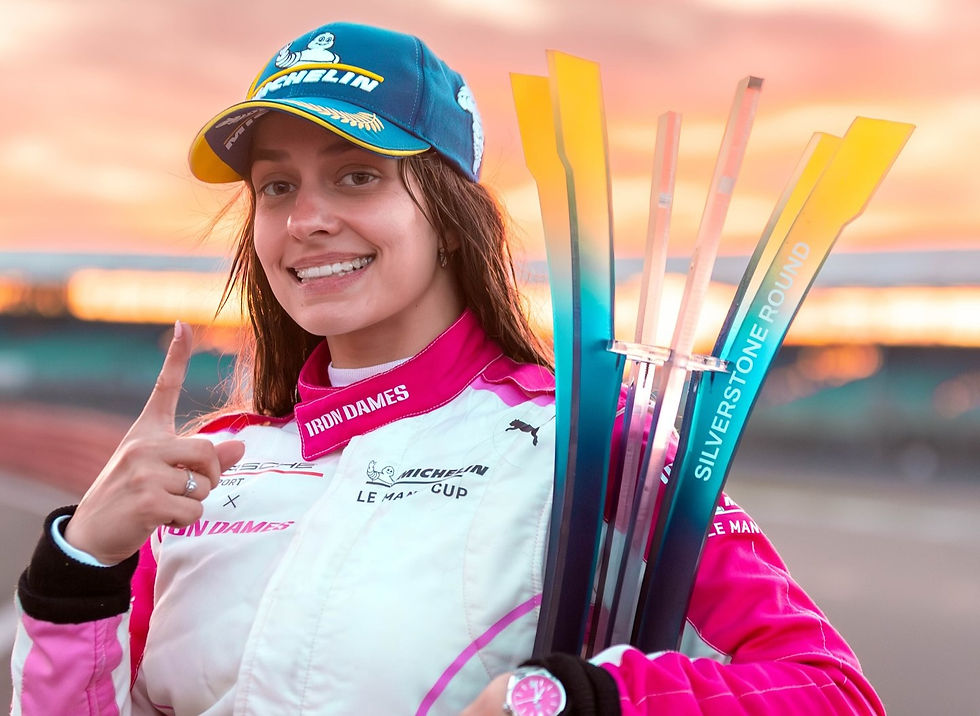
MARTA GARCÍA
The 2025 season marked a major new chapter in Marta García’s career, as the Spaniard completed her first full campaign in GT3 following a highly successful progression through single-seaters. After winning the inaugural F1 Academy title in 2023, García stepped up to the Formula Regional European Championship in 2024, while simultaneously beginning her transition into sportscars with Iron Dames in the Ligier European Series. She made an immediate impact in sportscars, claiming victory in only her second start and returning to the top step of the podium at Portimão - performances that paved the way for her promotion to GT3 machinery.
For 2025, García joined the Michelin Le Mans Cup with Iron Dames, sharing the Porsche 911 GT3 R run by Proton Huber Competition with Belgian racer Vanina Ickx. The season began with both promise and adversity. On her GT3 debut at Barcelona, García was leading the class when she was hit and launched heavily into the barriers, her Porsche catching fire in a major accident she thankfully escaped unharmed. At Paul Ricard, Ickx secured a front-row start, but early contact dropped the pair back before García mounted a strong recovery drive to finish fourth. Their toughest setback followed at Le Mans, where illness forced Ickx to withdraw, ruling the team out of the prestigious round.
From that point onward, momentum finally shifted. At Spa-Francorchamps, García and Ickx converted their pace into a breakthrough podium, finishing third to secure García’s first GT3 rostrum. The upward trajectory continued at Silverstone, where the duo took pole position and delivered a historic victory: after Ickx led the opening stint, García fought back from a contact to win by more than 40 seconds, sealing Iron Dames’ victory across all ACO categories.
The season finale at Portimão highlighted their speed once again, as they led most of the race before a pit-exit infringement denied them a deserved win, leaving them fifth at the finish. Despite missing a round, García closed her rookie GT3 season fifth in the championship standings, emerging as one of the most impressive GT3 newcomers of 2025 in the face of persistent misfortunes.

PATRICIJA STALIDZANE
Patricija Stalidzane celebrated her first-ever NXT Gen Cup victory at the Sachsenring, having opened her season with her first podium in the all-electric season at the first round in Oschersleben. The Latvian went on to enjoy an impressive weekend at the Norisring, where she finished third in both races and, at the season finale at the Sachsenring - the fourth round of the short calendar - Stalidzane achieved another milestone by securing her first-ever pole position in NXT Gen Cup, which also marked the first female pole position in the series’ history.
In her second year in the championship, Stalidzane had already shown strong promise in 2024, but 2025 represented a major step forward. Alongside her NXT Gen Cup campaign, she undertook a dual programme in the Nürburgring Langstrecken-Serie, racing GT4 machinery and also earning her first opportunity to test a GT3 car.
Balancing two very different forms of racing - endurance competition in the NLS with the all-female Girls Only team, and the aggressive sprint racing of the all-electric NXT Gen Cup - Stalidzane thrived from the start. She finished second in the Oschersleben opener, but a technical issue that prevented her from starting Race 3 dealt a significant blow to her title hopes in the short championship. She returned to the podium at the Norisring after leading part of the race on the historic street circuit, finished third again in Race 3, and endured further bad luck at the Nürburgring.
Her breakthrough however came at the Sachsenring, where she claimed pole position in Race 1, took her maiden victory in Race 2, and closed the season with another third place in the final race to secure fourth overall in the standings. Across the year, Stalidzane demonstrated a very solid combination of racecraft, speed, and strategic intelligence, key in NXT Gen Cup.

LÉNA BÜHLER
Léna Bühler was undoubtedly one of the standout drivers of 2025, providing another clear example of a successful transition from single-seaters to sportscars. Stepping into LMP3 prototypes in the highly competitive Michelin Le Mans Cup, she was immediately on the pace.
Vice-champion in the inaugural F1 Academy season, Bühler made her move into endurance racing this year with 23Events Racing, forming an all-rookie line-up alongside Matteo Quintarelli. The duo impressed from the opening round in Barcelona, where Bühler recovered from first-lap contact to secure a top-five finish while frequently setting fastest laps.
At Le Castellet, they again fought for a podium before a penalty dropped them down the order. Their breakthrough came at the prestigious Road to Le Mans double-header supporting the 24 Hours of Le Mans, where Bühler claimed a sensational overall victory in Race 2. The momentum continued with a fifth place at Spa-Francorchamps after a recovery drive from a difficult qualifying session, followed by another top-five result at Silverstone, marking her fourth top-five finish of the season.
Bühler concluded an impressive rookie campaign with a top-ten in the season finale at Portimão, once again demonstrating front-running pace that was not always rewarded due to misfortune. Nevertheless, her season highlight remains her historic triumph at La Sarthe, where she became the first woman ever to win a Michelin Le Mans Cup race outright.

CHLOE CHAMBERS
Chloe Chambers also earns a deserved spot in our top ten drivers of the year. The American completed her second and final F1 Academy season with a stellar title challenge, ultimately falling short but establishing herself as a worthy rival to Doriane Pin and Maya Weug.
Racing with Campos Racing for Red Bull Ford, Chambers had already claimed a victory in 2024 and quickly emerged as one of the title contenders in 2025, demonstrating pure pace from testing through the opening rounds. She began the season strongly, securing two podiums in Shanghai with second and third-place finishes, along with the fastest lap, before taking pole, second, and fastest lap again in Jeddah. Consistently one of the best overtakers in the reverse-grid races, she added a third-place finish in Miami and repeated her qualifying dominance in Montreal, converting pole into a victory in the third race.
Her title hopes suffered a setback in Zandvoort, where a technical issue prevented her from starting the second race after finishing in the top five in Race 1, but she bounced back to the podium with third in Singapore.
Entering the Las Vegas finale no longer in contention for the championship, Chambers showed anyway her fighting spirit, taking a fourth pole position, the fastest lap, and a win in Race 2 to finish third in the standings. Excelling in both GT racing and single-seaters, Chloe has consistently been an exciting driver to watch, impressing with daring overtakes, raw speed, and a strong, engaging personality.
HONORABLE MENTIONS

Notable mentions go to several drivers who impressed throughout the season and received more than a vote. The Iron Dames main lineup stood out, with Michelle Gatting in her first year as a Porsche official driver often delivering excellent defensive stints in the closing stages of the world’s top endurance races, consistently holding her own. Rahel Frey, vastly experienced and still one of the fastest silver-rated drivers around, showed remarkable consistency and speed, guiding the team through the most challenging WEC rounds where strategy and optimization were key.
In her first season as a silver-rated driver, Sarah Bovy was equally impressive, regularly matching the pace of higher-rated competitors and delivering a very strong ELMS campaign. Célia Martin also deserves recognition for a solid debut as the Iron Dames’ main bronze driver, frequently performing as the top bronze contender in ELMS, with strong starts and consistent race pace throughout the season.
Outside the Iron Dames program, Rio Shimono dominated the all-female Kyojo Cup, winning eight out of ten races and finishing on the podium in every event, with only two third-place finishes as her lowest results. She concluded the season with 149 points, 51 ahead of her closest rival, Miki Onaga.
Samantha Tan, another consistent performer in our lists, narrowly misses out on out top ten spot for 2025 but remains a highlight, claiming the GTX Bronze title in her first solo GT3 season in the IMSA VP Sportscar Challenge.
MOMENT OF THE YEAR

IRON DAMES WIN AT EVERY ACO LEVEL
Marta García and Vanina Ickx secured a historic first Michelin Le Mans Cup victory for the Iron Dames at Silverstone, converting pole position into a dominant win. After Ickx’s strong opening stint, García overcame an incident and a time deficit of more than 30 seconds to cross the line with a margin of over 40 seconds, marking the Spaniard’s first GT3 triumph on only her fourth start. This victory followed a third-place finish at Spa-Francorchamps and made up for earier misfortunes in the season.
The Silverstone weekend was in fact another breakthrough moment for the all-female Iron Dames squad, who not only celebrated their first Le Mans Cup victory but also secured the team’s successes at every level of ACO competitions - from the Ligier European Series and Michelin Le Mans Cup to the European Le Mans Series and FIA WEC: Iron Dames became the first team in history to achieve wins across all categories.
García and Ickx showed speed throughout the campaign, mastering Silverstone’s mixed weather challenges and maximising a flawless strategy. The race itself was eventful, with multiple safety car periods, on-track incidents and penalties. García however showcased kept the car clean, methodically closing gaps and overtaking rivals to claim the lead in the closing stages. By the chequered flag, she had extended her advantage to more than 40 seconds, claiming a breakthrough result for both herself and the Iron Dames program.

LÉNA BÜHLER WINS AT LE MANS
Léna Bühler, who also made our top ten list, made history at the Circuit de la Sarthe by becoming the first woman ever to win a race outright in the Michelin Le Mans Cup, securing a spectacular overall victory in Race 2 of the Road To Le Mans double-header - the flagship event of the championship, held in support of the 24 Hours of Le Mans. The triumph marked her first win in prototype racing and came on only her third race weekend in LMP3, showing her adaptation to endurance racing.
In her debut season with 23Events Racing with fellow rookie Matteo Quintarelli, Bühler had already shown front-running pace earlier in the year, narrowly missing podiums and victories. The Le Mans weekend itself was initially disrupted by red flags in qualifying, leaving Bühler fifth for Race 1 and fourth for Race 2. In the opening contest, she fought back from early trouble to regain positions before handing over to Quintarelli, who climbed into the top ten, eventually finishing seventh, continuing a pattern of strong results despite misfortunes.
Saturday’s Race 2 however delivered the breakthrough. Bühler made a stunning launch from fourth, capitalising on first-corner chaos to jump into second and immediately applied pressure to the leader before multiple safety-car interruptions compressed the field. After a controlled and rapid opening stint, she handed over to Quintarelli, who survived a tense final phase and a dramatic last-lap duel to defend the lead and seal the duo's first Michelin Le Mans Cup victory. The result represented a historic moment on the sport’s biggest stage, with Bühler taking victory at Le Mans.

LILOU WADOUX WINS PETIT LE MANS, TAKES IMSA TITLE
Lilou Wadoux was the protagonist of a stunning performance at the Motul Petit Le Mans, sealing both a dominant GTD victory and the IMSA Michelin Endurance Cup title alongside AF Corse teammates, driving the #21 Ferrari 296 GT3. The Ferrari factory driver completed a season of strong pace with a flawless finale, becoming the first woman to win an IMSA title since 2017. Wadoux also set the fastest GTD lap of the race and was consistently among the quickest drivers on track, securing her first GTD victory in North America after previously winning in LMP2.
Starting the 10-hour finale, Wadoux navigated an opening phase marked by first-lap accidents, multiple cautions and bouncing back from an early penalty. Down to tenth in class, she responded with a stunning recovery, becoming the fastest GT driver on track and charging back through the field with a sequence of overtakes. By the time she handed over after the opening pit cycle, she had erased the penalty, returned the Ferrari to the front group, and laid the foundation for the team’s control of the race as the #21 crew moved into the lead during the following caution periods.
The AF Corse trio executed a relentless rest of the contest through the day and into the night. Wadoux reinforced the lead in long green-flag runs: in her second stint, Lilou again dominated and retained the lead despite traffic and further cautions. Wadoux’s contribution proved decisive, as she showed race-winning pace to seal both victory and her first GT3 title.
HONORABLE MENTIONS
Laura van den Hengel's title winning campaign in GT Cup Europe offered several notable moments, as well as two European Le Mans Series weekends which proved to be particularly remarkable for women in motorsport: the Barcelona season opener, with Jamie Chadwick securing victory in LMP2, alongside a Iron Dames win in the LMGT3 class - and the 4H of Le Castellet, where Chadwick won overall and was followed on top of the LMGT3 podium by Lilou Wadoux, with female drivers dominating the weekends.
The final Saudi F4 round at the Jeddah Corniche street circuit was another historic moment for the sport, as female entries for the first time surpassed the male participants.
Emily Cotty's top ten in qualifying at Barcelona in Italian F4 deserves a mention, as well as NXT Gen Cup's final round at Sachsenring which saw victories from Siri Hokfelt and Patricija Stalidzane. The
Formula E’s second women’s test provided 14 women with six hours of vital experience in the latest FE Gen3Evo car at Circuito Ricardo Tormo, with Chloe Chambers topping both sessions.
ROOKIE OF THE YEAR

MARTA GARCÍA
Marta García has been voted best rookie of 2025 from our website's correspondents, having translated her single-seater experience into front-running GT3 performances in her very first full season in GT racing. After earning her promotion through the Iron Dames programme, the Valencian enjoyed immediate success in Michelin Le Mans Cup, despite facing a tough campaign: despite a fiery crash and the heartbreak of missing Le Mans, García responded with fighting spirit, maturity and pace beyond her experience.

JAMIE CHADWICK
Jamie Chadwick takes the title of prototype rookie of the year for the impact she made in her very first full season in LMP2 machinery. Stepping into endurance racing at the top of the European prototype ladder, Chadwick adapted with remarkable speed, becoming an immediate front-runner in the European Le Mans Series with IDEC Sport. Across the season she secured three class victories, two of them overall wins, and finished third in the championship, consistently delivering competitive stints against some of the most experienced prototype racers in the paddock.

EMILY COTTY
British-New Zealand teenager Emily Cotty formally made her F4 debut in 2024, contesting a round in British F4, but her real breakthrough came in 2025 in a very busy season for the R-Ace GP driver, who entered F4 Middle East Championship, Formula Winter Series as preparation and then the uber competitive Italian F4 and the continental E4 Championship.
Cotty started off with rookie podiums in the Middle East, before making a name for herself in the Italian series, where she was consistently in the top-20, qualified in the top ten at Barcelona and claimed a personal best of P11, securing the Female Trophy title with 12 class wins. Cotty ended her full-time rookie campaign in F4 with the FIA F4 World Cup at Macau, where she was the only woman in the field.
HONORABLE MENTIONS

Alisha Palmowski emerged as one of the top rookies in F1 Academy, winning on her debut as a full-time driver in the Shanghai reverse-grid race. She had earned her place on the grid by winning the MSV Women’s Scholarship in the GB4 Championship the previous year, securing crucial career support towards an F1 Academy seat, and had already impressed with a wildcard appearance. In her first full season in the all-female championship, Palmowski claimed five podiums and finished fifth in the standings, just behind another highly convincing rookie, Ella Lloyd, who also took her maiden victory this year in Jeddah.
Alba Hurup Larsen and Emma Felbermayr were equally impressive. Felbermayr was one of the few drivers to make the direct step from karting to Formula 4 within the series and combined her programme with a Spanish F4 campaign, showing major development over the season. She secured her first race win in Montreal and emerged as one of the most promising F4 rookies.
Léna Bühler has already been extensively praised for her exceptional rookie campaign in sportscars and prototypes, highlighted by her race-winning season in the Michelin Le Mans Cup. The Al Qubaisi sisters also deserve mention for their step from single-seaters to prototypes in the Ligier European Series.
Another particularly interesting new name is Swedish-American Alexandra Hainer, who progressed from US club racing to make her professional debut in McLaren Trophy North America and the IMSA Michelin Pilot Challenge in the GS class, claiming a ProAm title in the former and an overall podium in the latter on her first attempt.
Many more drivers deserve recognition for their achievements during the past year; this is not intended to be an exhaustive list, but rather to highlight some of the most significant trends for women in motorsport, showing how talent continues to break through. Ensuring these drivers receive the support needed to keep progressing over the coming years will be crucial.


