Opinion: Why extending F1 Academy's 2-year rule may be counterproductive

F1 Academy has been the most influential force behind the surge in female participation in F4 worldwide; we analyse data from F4 progression paths and compare it with F1 Academy, which suggests that further adjustments are needed to ensure that female talents' progression is not delayed.

The F1 Academy all-female championship has completed its third season with the crowning of Doriane Pin as its newest champion, in a project that continues to attract growing global attention.
That attention has been fuelled not only by Formula 1’s promotional power and the Netflix documentary series, but also by a genuinely compelling on-track fight for the 2025 title, with Pin pushed hard by Maya Weug and Chloe Chambers; all three were fitting protagonists for a season that showcased the competitive potential of the series, and all three will now move on, having reached the two-year participation limit that prevents them from returning in 2026.
As the championship looks ahead, several changes have already been announced for the coming seasons. The 2026 calendar introduces an additional European round, a significant development for a series that has, in recent years, leaned heavily towards overseas street circuits.
While racing alongside Formula 1 has provided unmatched visibility, many of those street tracks are not commonly featured on the traditional single-seater ladder. For drivers preparing to graduate from F1 Academy into regional formula categories, the lack of exposure to permanent circuits has been a recurring concern. The debut of the British Grand Prix at Silverstone is therefore a step in the right direction - as is the return of Circuit of the Americas in Austin, replacing the Miami street circuit, offers another permanent venue that better aligns with the circuits drivers are likely to encounter as they progress.
The 2026 grid is already taking shape, with ten drivers confirmed at the time of writing. The line-up reflects a mix of new talents and returning drivers embarking on their sophomore campaigns. At the same time, seven drivers will be forced to move on at the end of 2025 after reaching the maximum allowed time in the championship.
This rule has often frustrated fans, particularly those who discover and emotionally invest in drivers through F1 Academy’s high-profile platform. Yet the two-year limit was originally introduced for a clear and well-founded reason: to prevent stagnation at Formula 4 level and to encourage progression back into mixed-gender championships.
That principle is now set to be challenged. On 13 November 2025, F1 Academy announced a new regulation that will come into effect from 2027, allowing select drivers to contest a third season if they demonstrate strong growth potential. While framed as a natural evolution following the series’ early success, this change raises serious questions about whether it truly serves the long-term development of the drivers the championship aims to support.
There is no doubt that F1 Academy has been the single most influential force behind the recent surge in female participation in Formula 4 racing worldwide. Following its launch in 2023, female participation at F4 level increased by 105%. That growth continued with a further 40% rise in 2024 and another 64% increase happened in 2025.

While the launch of Japan’s Kyojo Cup - another all-female series using F4 machinery - also contributed to the most recent figures, the trend remains striking even when those numbers are excluded. Global female participation in mixed-gender F4 championships in fact still rose by more than 29%, with 57 female drivers contesting at least one round in a mixed-gender F4 series, the highest number ever recorded.
F1 Academy has also played an important role further down the pyramid. Its influence has been felt in karting, supported by initiatives such as the renewed Champions of the Future Academy program. Over the past two years, that program has provided a clearer pathway for young female drivers, many of whom have not only participated but also won races across multiple karting categories. In that sense, F1 Academy has succeeded in stimulating interest, participation and belief at grassroots level.
Criticism, however, has often centred on whether the series genuinely helps drivers move up the single-seater ladder. That claim is a bit more nuanced. The inaugural 2023 champion Marta García was awarded a funded season in FRECA, with Léna Bühler also returning to the same category that year before finding a successul path in prototype racing - just like the Al Qubaisi sisters. Bühler became the first woman to win outright in Michelin Le Mans Cup, winning on the biggest stage in the world at Le Mans, while Hamda and Amna Al Qubaisi both were protagonists of the Ligier European Series, securing multiple podiums in their first year in sportscars, showcasing that high level opportunities are out there for F1 Academy drivers also outside single seaters.
Meanwhile, Doriane Pin combined her F1 Academy commitments with dual FRECA campaigns, while 2024 champion Abbi Pulling earned a funded seat in the highly competitive GB3 Championship. Bianca Bustamante also stepped up to GB3, a series that alongside Formula Regional should be the next logical step beyond Formula 4.

Pulling claimed a podium in GB3, along with multiple top-ten and top-five finishes, making her the most successful F1 Academy alumna so far in mixed-gender competitions. While it is fair to argue that drivers like Pin and Weug reached FRECA level regardless of F1 Academy, Pulling’s case illustrates a crucial point: without the financial backing provided by the series, that opportunity may never have materialised due to budget constraints for drivers like Abbi.
The real challenge for F1 Academy however now lies not in facilitating a single step up for its champions, but in proving that it can function as a sustainable career pathway for its strongest drivers beyond that initial promotion.
To date, no driver with F1 Academy on their résumé has reached FIA Formula 3 or FIA Formula 2, mirroring the outcome of W Series before it. That criticism is often raised with a reason, but it must be also acknowledged that F1 Academy is still in its infancy. Meaningful evaluation requires a longer-term view, particularly as the overall talent pool entering the pyramid has expanded significantly since the series’ launch.
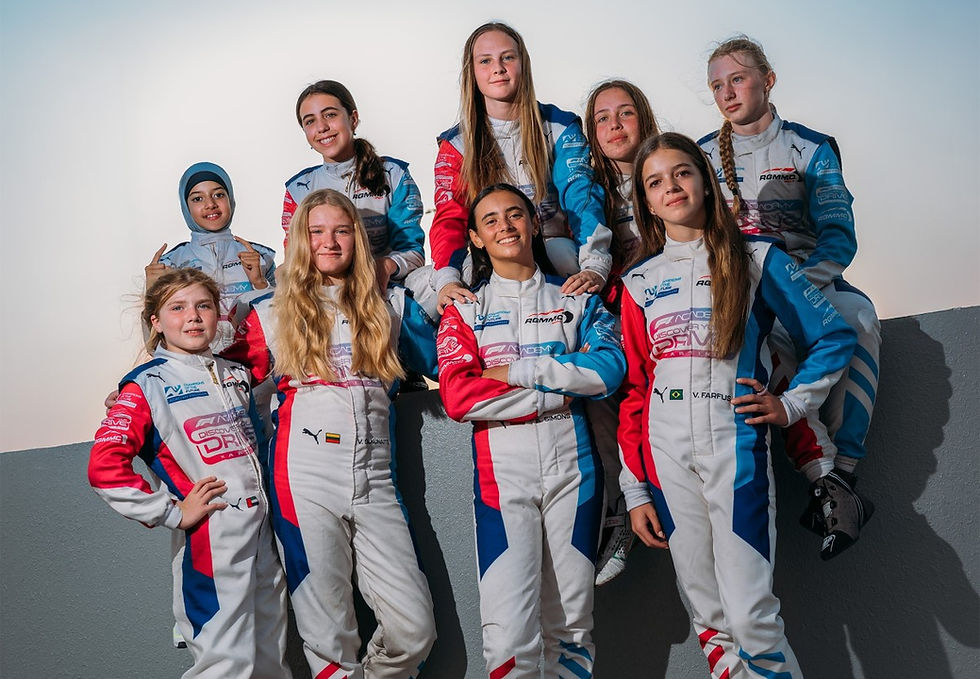
In response to the shortcomings of W Series, F1 Academy introduced two limits that were, at the time, both logical and necessary. The age cap of 26, while still high for an F4-level championship, represented a step in the right direction. More importantly, the two-year participation limit was designed to force drivers to return to mixed-gender championships, ideally equipped with increased visibility, experience, and backing from F1 teams and major sponsors. These constraints were intended to prevent drivers from spending excessive portions of their careers at Formula 4 level.
A closer look at the data reveals why those limits matter. Current full-time F1 Academy drivers average 53.17 races at F4 level, with many still expected to contest at least an additional F4 season in 2026. The seven drivers set to move on at the end of 2025 average 65.5 F4 races, having spent around three years at that level, and typically move up at an average age of 19.5.
By comparison, the nine drivers who moved on in 2024 averaged 89.1 F4 races over roughly four years, stepping up at an average age of 21.4. The group of drivers that moved on in 2023 averaged 61 F4 races across 2.5 years, but with a notably higher average age of 24.5.
When those figures are set against the profiles of current male drivers in the upper tiers of the single-seater ladder, the contrast is stark.

Current Formula 1 drivers average just 37.4 F4 races, spending around 1.71 years at that level, with an average age of 16.7 at their final F4 race. In FIA Formula 2, drivers average 45.1 F4 races when including those who never competed in F4, or 52.2 when those outliers are excluded, with roughly 1.7 to 1.9 years spent in F4 categories and an average exit age of 16.6.
FIA Formula 3 drivers show similar trends, averaging around 49 to 53 F4 races over approximately two years, with an average exit age of 16.5. It is therefore immediately obvious how F1 Academy drivers spend way too much time at F4 level.
The positive trend is that the average age of drivers moving on from F1 Academy is decreasing as the grid itself gets younger. Yet the underlying issue remains: female drivers still arrive at Formula 4 later than their male colleagues and, crucially, leave Formula 4 significantly later. This timing mismatch has long-term consequences, particularly in a ladder system where progression is tightly age-linked.
Several structural factors contribute to this imbalance. F1 Academy was initially conceived as a bridge between karting and Formula 4, offering a subsidised accessible budget. In practice, however, only a handful of drivers over the first three seasons have made that direct karting-to-F4 transition through the series.
The growing prestige and visibility of racing on the Formula 1 calendar has driven intense demand for seats, leading the series to prioritise drivers with prior single-seater experience. As a result, F1 Academy now effectively requires a level of F4 experience that mirrors regional championships, creating a disconnect with the traditional development routes followed by male drivers.
Racing license requirements also present another barrier. Because F1 Academy is classified as an international series due to its association with the Formula 1 calendar, drivers must hold an international FIA racing licence, which in turn requires them to be at least 16 years old. This age threshold alone prevents many promising female drivers from entering F1 Academy at the same stage their male peers are already racing in regional F4 series.

The consequence is a familiar pattern: female drivers arrive in F1 Academy older, stay for the maximum two years to capitalise on visibility and sponsorship opportunities, and leave with at least three years of Formula 4 experience. By that point, many of their male counterparts have already progressed through regional formula categories and FIA Formula 3.
Funding remains a central issue throughout this process. Previous analyses have shown that male drivers progressing up to F3 and F2 often combine multiple programs within a single season in F4, amassing extensive race and testing mileage.
In the previous years, female drivers - often operating within tighter financial constraints - rarely had that luxury. 2025 data however shows encouraging signs, with only three F1 Academy drivers not contesting any mixed-gender races. However full-time dual campaigns remain a priority to pursue. This is particularly crucial given that the F1 Academy calendar has shrunk from 21 races in 2023 to 14 in both 2024 and 2025, with practice sessions shortened due to the F1 schedule and collective test days now set to reduce from 15 to 12 in 2026.
The data now clearly shows that F1 Academy drivers are reaching high total numbers of Formula 4 races, but spread across too many years before stepping up. This is precisely why the proposal to allow three-year stints in F1 Academy is concerning.
While well-intentioned, it risks entrenching the very problem the series was designed to solve; rather than extending time at F4 level, the focus should shift towards accelerating progression for the most promising drivers - even if that means encouraging them to move on after a single season without having secured a title yet.

Lowering the license age requirement to 15, in line with most regional F4 championships, would be another crucial step. It would allow female drivers to enter the series earlier, align more closely with male development timelines, and reduce the need for prolonged stays at Formula 4 level.
The visibility F1 Academy provides is invaluable, and the growing fanbases around its drivers represent a major opportunity for the protagonists. However, fans must be encouraged to follow these drivers beyond F1 Academy, rather than viewing their departure as a step backwards simply because of the “F1” branding attached to the series.
F1 Academy has already delivered undeniable progress, offering clearer pathways, lower entry costs compared to regional F4 series, and an increasingly open paddock that allows drivers to build connections with fans, in the rarely fan-friendly F1 paddock. Yet, if it is to truly fulfil its mission, further adjustments are needed to ensure that visibility translates into sustainable, long-term progression. Supporting female drivers to move up sooner, rather than stay longer, may ultimately prove to be an important step in closing the gap on the single-seater ladder.


